Independent power producers (IPPs) face an exits crisis. Sales of IPPs have almost stopped clearing: Opus believes nearly one in four European IPPs sits unsold.
The market has changed. Sponsors need a new playbook to satisfy LPs. This requires clearsighted causal analysis, and new strategies. Here, Opus argues the answer lies in portfolio breakups and IPP mergers to create Tri-tech IPPs.
From goldrush to gridlock
Once upon a time, IPPs were the most liquid assets in infra-land. Developers built pipelines, sponsors scaled platforms, and exits followed. Rising decarbonisation commitments, falling technology costs, sovereign offtake mechanisms and abundant liquidity supported a steady cadence of platform sales. M&A activity in renewable developers surged, with Europe accounting for ~ 40% of transactions.
Acquisitions of wind and solar developers

Source: Opus, Dealogic
That market no longer exists. In 2023, interest rates swelled. Power prices dropped. PPA volumes fell and fell again. Permitting slowed. Deal timelines extended. The music stopped. Expectations reset.
The first casualty was valuation. Renewable energy multiples have compressed sharply. It is reported that EV/EBITDA valuations FELL from approximately 15x in 2020-2023 fell to c10x by 20251 ,tracking the investment trusts sectors. ‘Platform value’ was eviscerated. Then pipeline value dissipated. Within IPPs, the value migrated from development to construction: the monetisation of pipelines.
IPPs now trade closer to their operating asset values. That is a problem. It widens the bid–ask spread to the point of immobility. Processes are launched. They rarely clear. S&P data suggests H1 25 saw a 75% global fall in exits values2 . Opus data for Europe show an equally dramatic, and troubling pattern: overwhelmingly, most IPP exits now fail.
Willing sellers are deterred by high unsold inventory

Source: Opus, Dealogic
This degradation in volumes, valuation, quality, structure, and certainty, has a label: it’s a crisis.
So inventory builds
The consequence is an accumulation of unsold IPP inventory. Sponsors have launched strategic reviews, explored exits, and then quietly stepped back when valuations disappointed, creating a chilling backlog of unsold inventory. Opus has tracked 24 currently unsold IPPs: over 20% of our European IPP universe. Many used mezzanine leverage to bridge these transaction gaps: the tragedy of Enerparc is a stark warning of the risks.
The troubling volume of unsold IPP inventory
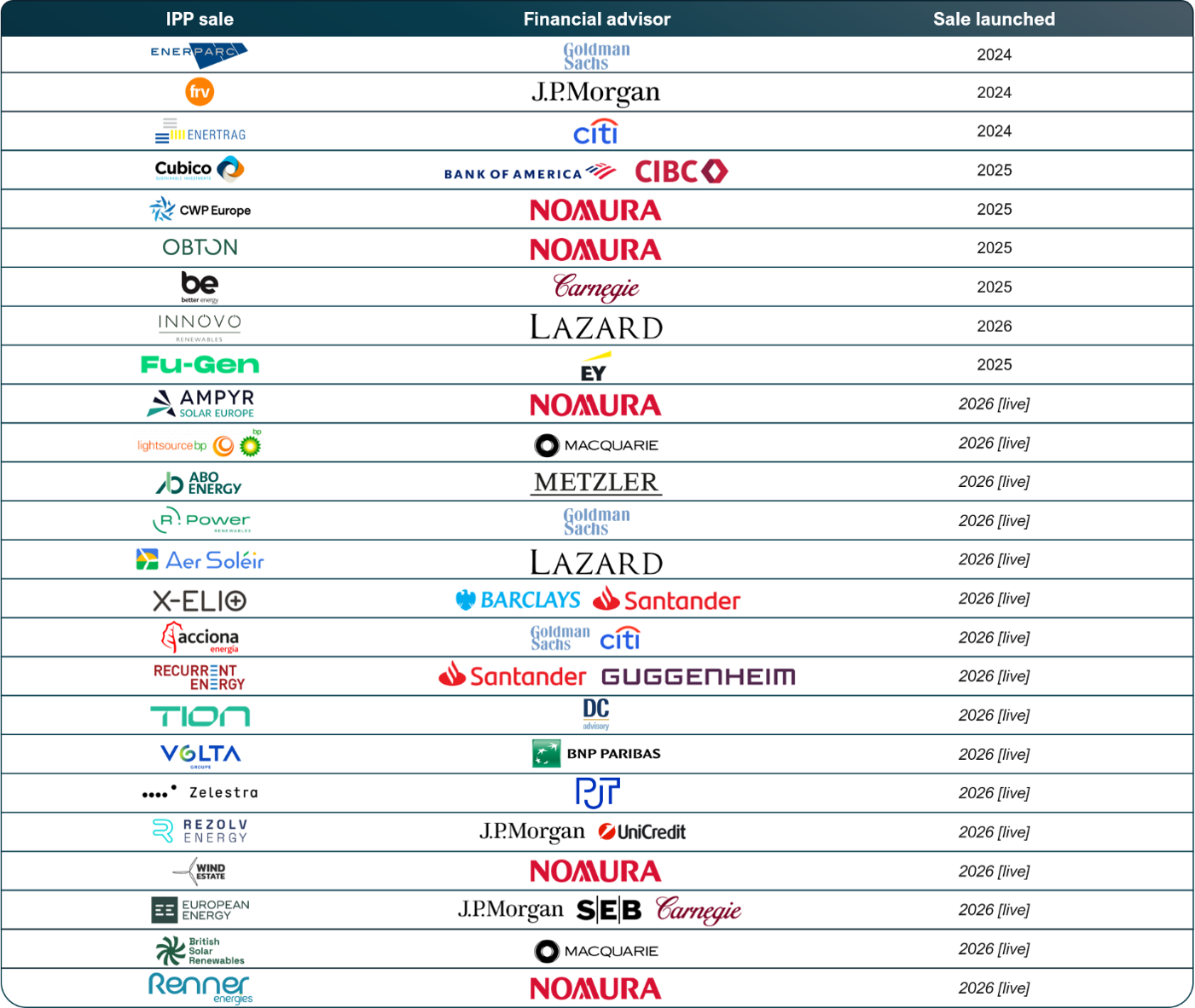
Source: Opus estimates, industry sources
Unsurprisingly, many sponsors now defer exits, hold periods lengthen, completion risk rises. For an industry already under pressure on DPI ratios (cash recycle ratios), this is problematic.
Evolution is your solution
Within the IPP ecosystem, new models are thriving. The single technology, multi-country solar IPP’s model (IPP 1.0) is outdated. The IPP 2.0 model (aka Next Gen IPP) is healthy: these agile adaptations manage risk in an increasingly merchant market.
But the evolution must not stop there. The need is for resilient Tri-Tech IPPs whose technology diversification (batteries plus two asynchronous generation technologies like wind, gas or solar) facilitate the surging hybrid PPAs that satisfy customer demand. This model is client-centric, not project-centric, using hybrid PPAs to meet customer load profiles and commercialise stranded single technology projects by delivering green baseload power to large industrial customers and data centres. Their resilience attracts new vintages of infra funds.
Tri-tech IPPs are not born. They are artifacts of active portfolio construction and strategic M&A. Tri-techs require strategic repositioning and bold execution. We highlight:
Opus believes these strategies create desirable IPPs: by converting commodity electrons to premium services, they bypass price cannibalisation in single source PPAs. Future-proof, with stronger returns, they should achieve higher valuations and should see strong demand at exit.
We made the case for IPP 2.0 since October 2023. Since 2025 we have advocated for the Tri-Tech IPP as the next evolution of this model. We are not clairvoyant, we simply follow the unequivocal data: follow the money. The chart below shows volumes of customer demand for energy. They are migrating from solar.
European PPA demand changed rapidly in 12 months

Source: Opus, Pexapark
These hybrid PPAs are not just colo solar: the majority combine solar and onshore wind. Hybrids are already the dominant form of PPA in primary European markets like Spain, Germany, as well as much of CEE.
And this revolution is not only in volumes. The impact shows in pricing too: LevelTen report European hybrid PPAs in H1 26 priced 24% above solar PPAs. There is higher demand, at higher prices. Together, these signal the demise of the old-model 1.0 IPP.
So Opus’ belief is that a business model offering highly sought solutions (hybrid PPAs) and achieving premium prices creates a new apex predator in renewable generation: Tri-tech IPPs able to acquire the unsold inventory of stranded single technology IPPs and uplift their value through superior offtake products. They will retain exit optionality and premium pricing.
The market still needs to clear the inventory of outdated 1.0 IPPs that lack the vision or resources to become Tri-Tech. There are a few ways this resolves:
It is our view that only the breakup option (number 3) makes sense at this point: portfolio reconstruction can facilitate strategy evolution to a Tri-tech IPP. We see this with Orsted, Qualitas and others who had failed IPP sales.
When platforms don’t sell, assets do
And we believe this is what is happening. Market activity has adjusted. Cero aside, corporate-level exits are subdued. Instead, activity has migrated below parent level:
In other words, liquidity has not disappeared. It has fragmented. In addition, with TopCo mezzanine funding revealing its dangers through Enerparc, IPPs seeking new sources of intermediate funding are likely to turn to higher volumes of portfolio sales.
Conclusion
The European renewables market has not stalled in a traditional way: capital is flowing, capacity is growing. But the exit mechanism — the ability to profitably recycle capital through platform sales — has broken down. This is no mere inconvenience, it is a threat to infrastructure’s modus operandi.
Too many assets remain where they are: on balance sheets, in portfolios, and increasingly, on the market — but not sold. Opus argues that the answer is not to ‘wait this out’ but to adapt strategy, evolving single generation technology IPPs to become geographically concentrated, Tri-technology, customer service and risk management solutions selling uninterrupted green power. Reconfiguring power portfolios enables this focus and this strategy to be delivered.
Every parent one day tells a child that breakups are hard, but often for the best. Guardians of 1.0 IPPs must now do the same. Piling on leverage is not a sustainable solution. Country exits are needed, and the buyer demand is there – this problem spans the renewable energy industry – but it is increasingly accessed off-market, through proactive bilateral solicitation. This is a labour-intensive process, suited to financial advisors with strong IPP board access. For 20 years Opus has been adapting to these energy infrastructure’ evolutions. It requires more than mere process execution to solicit and craft these strategic solutions, but we believe we can turn this IPP exits crisis in to opportunity, for those willing to face these uncomfortable facts.