
The UK has the feedstock, the grid and the know-how to build a major biomethane industry. What it lacks is industrial scale. The opportunity is to consolidate a fragmented base of anaerobic digestion (AD) plants into larger platforms that can lower costs, optimise performance across portfolios, secure long-term offtake and compete with natural gas.
More than a decade of development has created over 500 AD sites, including more than 120 injecting biomethane into the grid. Despite this expansion, production reached just 6 TWh in 2025, around 1% of GB gas demand. NESO puts sustainable potential at around 30 TWh, with its Future Energy Scenarios reaching as high as 64 TWh by 2050.
The issue is not potential, but execution: moving from a subsidy-led market to a commercially driven industry.
Europe is moving, but hasn’t cracked this either
European biogas and biomethane production grew 34% between 2015 and 2024 to 232 TWh, accelerated by the renewed focus on domestic energy security following Russia’s invasion of Ukraine.
Yet penetration remains low in most markets: around 1.2% of gas demand in Germany, 1.3% in the Netherlands and 3.9% in France. Denmark stands out at 32%. There is no exceptional gas-price tailwind behind this success: Danish industrial gas prices before tax are broadly in line with the EU average. Its system and feedstock base differ from the UK’s, making it a benchmark rather than a blueprint. What it demonstrates is clear: biomethane can move beyond being a niche fuel when the conditions are right.
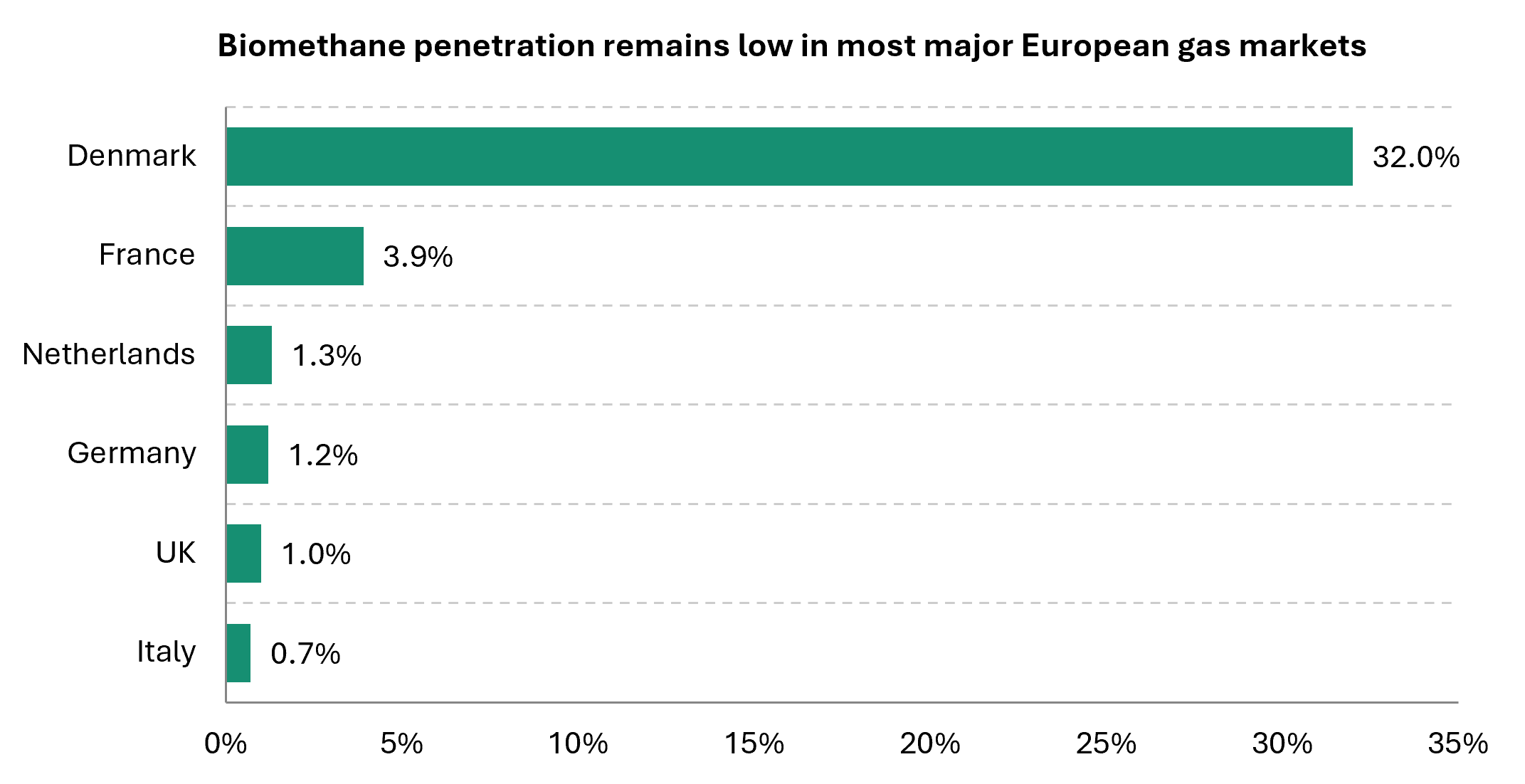
Indicative 2025 biomethane share of national gas consumption. Definitions vary slightly by country.
Sources: NESO (UK); Bundesnetzagentur (Germany); CBS (Netherlands); SDES and CRE (France); Danish Energy Agency (Denmark); MASE and Snam (Italy).
Denmark’s lead is also reflected in plant size. The UK’s 120 biomethane plants average around 50 GWh a year, compared with 129 GWh across Denmark’s 58 plants. At the top end, Denmark’s Tønder plant produces over 410 GWh, almost three times the output of the UK’s largest plants. A gap that is hard to ignore.
Bigger plants, cheaper green gas
This isn’t the electron world of solar and wind, where nothing has to be grown, collected or hauled in. Feedstock must be contracted, moved and blended daily. Biology, digestate, methane leakage and increasingly CO₂ all have to be actively managed. That operational complexity is where scale earns its keep.
Biomethane may not follow the dramatic cost reductions seen in solar, but scale can materially narrow the gap with natural gas. NESO estimates current UK levelised production costs at £73 – 135/MWh, compared with £41/MWh for natural gas, including carbon costs, in 2025. With gas prices now above £70/MWh before carbon costs, biomethane is looking increasingly competitive, but there is still some way to go.
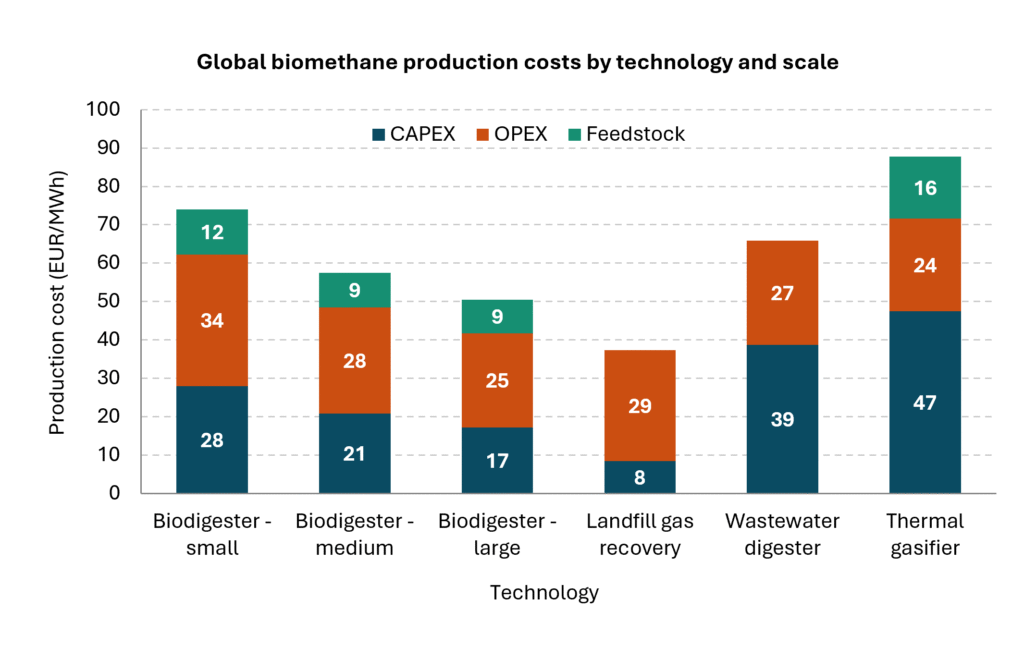
Source: Recreated from IEA (2025), Outlook for Biogas and Biomethane. Notes: small = <250 m³/hour; medium = 250–1,000 m³/hour; large = >1,000 m³/hour. Capital costs are levelised over lifetime production. Underlying USD/GJ values have been converted to EUR/MWh using 2025 exchange rates and rounded.
IEA analysis shows why size matters. Its global model puts average global production costs at around €74/MWh for small biodigesters and €51/MWh for large ones. Within this, Europe sits towards the higher end of the range, averaging around €74/MWh.
But size alone isn’t the answer. Larger operators can improve feedstock procurement, transport and operating performance, while stacking income from gate fees, renewable gas certificates, digestate and CO₂. Industrialising the whole operation is how biomethane closes the green premium vs natural gas.
Permanently storing biogenic CO₂ could make scale even more valuable. HyNet and the East Coast Cluster are developing the core storage infrastructure, while the Non-Pipeline Transport (NPT) Pathfinder could connect dispersed plants by road, rail or ship. The GGR Business Model could support early projects, with future recognition under the UK ETS creating longer-term demand for engineered removals. But this is a volume game: aggregating CO₂ across multiple plants will be key to making the economics work.
Feedstock opportunity is national, economics are local
On paper, the UK has plenty of resource. NESO sees significant growth potential from crops, agricultural residues and livestock waste, with enough sustainable feedstock to reach around 30 TWh before material trade-offs emerge. Nearer term, Simpler Recycling should provide a welcome boost to food waste feedstock supply, particularly for platforms with strong collection capabilities.
In practice, feedstock behaves more like fresh milk than crude oil: haul it too far and the economics sour. Collection radius, transport costs and methane yield can make or break a plant, and a good national resource number can still produce a bad local project. The same logic applies downstream. More production means more digestate: a useful substitute for fertiliser if managed well, an environmental headache if not. All of which means that scale still has to work locally.
The winners will combine strong local feedstock relationships with more efficient procurement, operations and commercial offtake. Done well, consolidation can deliver local strength at national scale.
The next policy framework needs to do more than write cheques
A clock is also ticking for the sector. Much of the UK’s AD fleet was built on legacy support through the RHI, FiTs and ROCs. ADBA estimates more than 160 plants will come off support within five years, with over 400 more in the following five. Smaller, single-tariff plants will have to adapt to a more commercial market or risk shutting down, adding pressure for consolidation.
Policy has driven almost every phase of European biomethane growth, and Denmark shows both what it can unlock and where the limits are. Its 2012 – 2020 Energy Agreement expanded the market and brought E.ON, Shell and Ørsted into the sector, but the cost of generous subsidies eventually pushed the support regime towards competitive tenders.
The UK now faces a similar question. The GGSS closes to new applications in March 2028, but another production subsidy cannot be the whole answer. Its successor must correct the weaknesses of previous schemes: tiered RHI and GGSS tariffs encouraged some plants to size around subsidy bands rather than operating efficiency. Policy also needs to pull demand as well as push supply. The RTFO already does that in transport. The bigger gap is industry and power, where the UK ETS still does not recognise grid-injected biomethane. Government must fix that to unlock demand from some of the hardest-to-electrify sectors.
Larger platforms would also give the industry a stronger voice in shaping the next framework.
Corporate offtake rewards size
Corporate climate commitments are beginning to translate into bankable demand for biomethane. AstraZeneca’s 15-year GPA with Future Biogas supports 100 GWh a year and the UK’s first unsubsidised plant. PepsiCo UK’s 10-year agreement for 60 GWh a year will underpin a new ENGIE plant in northern England. Both show that buyers will commit where credible operators can deliver reliable volumes and a clear route to decarbonisation.
As demand grows, larger operators will be better placed to aggregate volumes and provide flexibility across a portfolio. Long-term GPAs can then provide the revenue visibility needed for further investment.
New demand is also plugging in. Pure Data Centres recently procured 9 GWh of certified German biomethane on a mass-balance basis for its Irish operation. It is an early example, but data centres could become a sizeable market for platforms able to source, certify and trade gas across borders.
From a collection of AD plants to an industry
Biomethane matters most where electrons struggle: hard-to-abate industry, heavy transport, dispatchable power and selected heat uses, with its role extending to carbon removals through the capture of biogenic CO₂.
To level up, the industry needs to move from individual assets to scaled, professionally managed operators. For investors, buying AD plants and waiting for demand to rise is not the play. The opportunity is to bring strong operators and assets together into businesses that capital will back at scale.
Government has its part to play too: recognising grid-injected biomethane under the UK ETS, creating demand beyond transport and reducing reliance on production subsidies.
Infrastructure sectors mature through consolidation by driving costs down and returns up. Now it is UK biomethane’s turn.